


On October 14, the Second Ministerial Meeting of the IAEA World Fusion Energy Group (WFEG) and the 30th IAEA Fusion Energy Conference (FEC) took place in Chengdu, Sichuan province.
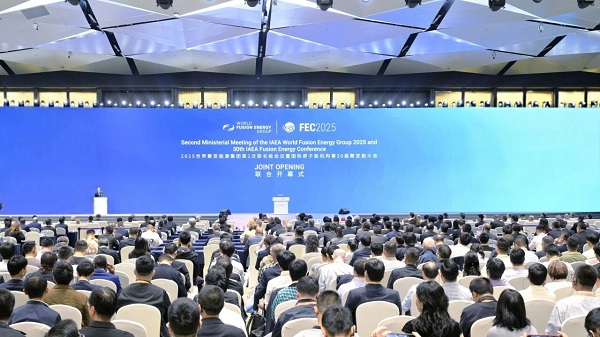
The conferences focused on key topics such as magnetic confinement fusion experiments and validation, theory and simulation, fusion technologies, inertial confinement fusion, and other innovative fusion concepts. During the event, the Outlook for Fusion Energy 2025 report and the Chengdu Statement of the World Fusion Energy Group were released. Nearly 2,000 delegates attended the events, including ministerial-level officials and senior representatives from 28 countries, as well as experts and scholars, industry leaders, and heads of international organizations from 61 countries and regions.
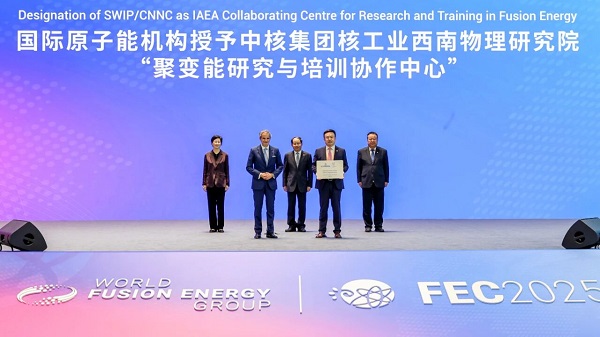
The events highlighted the latest achievements in international and domestic collaboration and innovation in fusion research. At the conference, the Southwestern Institute of Physics under the China National Nuclear Corporation (CNNC) was officially designated as an IAEA collaborating center for research and training in fusion energy.
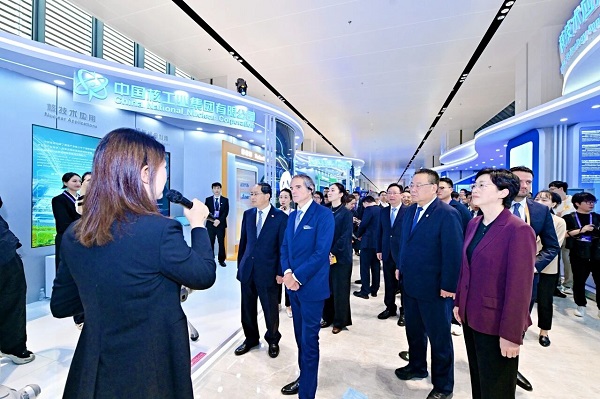
CNNC's exhibition booth, themed "Infinite Nuclear Power, Shared Future", showcased major scientific and technological innovations such as the new-generation "artificial sun" HL-3 and Hualong One, along with CNNC's capabilities in nuclear energy utilization, nuclear technology applications, engineering construction, environmental protection, and international cooperation. Through interactive models, a digital "Smart Nuclear Energy City", and virtual digital guides, the exhibition vividly demonstrated CNNC's dual role as both a pioneer in nuclear science and technology innovation and a key partner in global nuclear cooperation. It reflected CNNC's full industrial chain advantages and unwavering commitment to advancing the sustainable development of nuclear energy worldwide.
Jointly organized by the Chengdu municipal government and CNNC, the two landmark fusion events have provided a high-level platform for global exchange and cooperation in fusion energy. They will further strengthen international collaboration in fusion research, technological innovation, and industrial development, injecting new momentum into global efforts to tackle climate change, achieve green and low-carbon transformation, and build a cleaner and more sustainable world.